
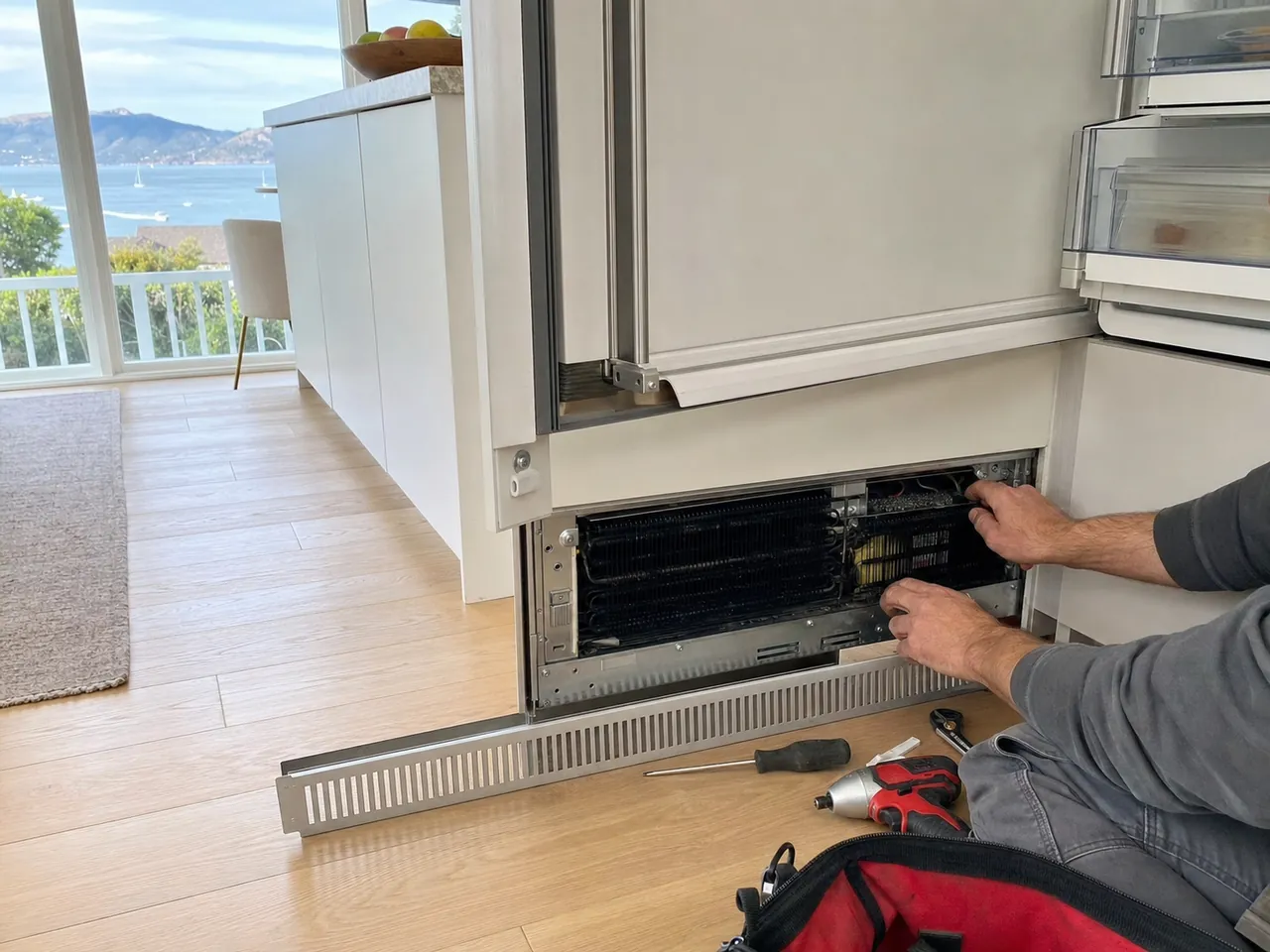
Climb the wooden stairways above Bridgeway into Old Town and you find some of the oldest kitchens in Sausalito — cottages from the 1910s and 1920s, remodeled in waves, many of them still running a Sub-Zero that went in during a 1980s or 1990s renovation. These long-serving classics are the machines owners call us about most often with the same question: it still runs, but should I keep pouring money into it, or is it time?
There is no single answer, but there is an honest way to think about it. This guide walks through what genuinely changes once a Sub-Zero is thirty or forty years old, written for the specific reality of an Old Town kitchen rather than a showroom.
Why Old Town keeps so many old units running
Old Town's housing stock rewards keeping things. The cabinet openings in a 1920s cottage were sized to whatever went in during the last remodel, and a built-in Sub-Zero is fitted flush into custom millwork that was scribed to the wall. Replacing the unit is rarely a like-for-like swap — the new model's dimensions, hinge side, or panel system seldom match the old cutout, so a simple fridge change can pull in a cabinetmaker. That math is why a well-built classic in a tight Old Town kitchen often deserves a repair that would not pencil out in a newer, standard-sized opening.
What age actually changes
Three things shift as a Sub-Zero passes its third decade. First, the sealed system: the original units were built to last and many still hold a charge fine, but a compressor or a slow refrigerant leak on a unit this old is the one repair where the numbers can argue for replacement. Second, the cosmetic and mechanical wear — gaskets, fans, hinges, the lower-grille condenser — which are almost always economical to renew and are what keeps a sound classic going. Third, the refrigerant era itself: the oldest units predate the refrigerant changes of the mid-1990s, which affects how a sealed-system repair is handled and is worth understanding before that specific job is quoted.
The refrigerant question, briefly
Sub-Zeros built before the mid-1990s generally used an older refrigerant that was phased out under federal clean-air rules; later units moved to its successor, and the newest use a different class again. For everyday repairs — a fan, a gasket, a control, a drain — none of this matters. It only becomes relevant if the sealed system itself needs to be opened, where the era of the unit shapes the approach and the cost. Our piece on the technician credential behind that work, the day-one reality of refrigerant handling, explains why the person, not the company, has to hold the federal credential for it.
Parts: the real constraint on a classic
The honest limiter on an old Sub-Zero is not usually the repair skill, it is parts. Common wear items for the popular built-in series of the 1980s and 1990s are still widely available, which is exactly why those units are so repairable. Where it gets harder is a discontinued control board or a model-specific part for a less common variant, and that is where keep-versus-replace tips. Reading the model and serial tag first — covered on our model number guide — tells us in minutes whether the parts path is open or narrowing.
An honest keep-or-let-go lens
Our rule of thumb for an Old Town classic: if the cabinet and door shell are sound, the fault is a wear item, and the parts are available, keep it — a thirty-year-old Sub-Zero that has been maintained is often a better machine than a mid-range new one, and it already fits your cabinetry. Lean toward replacement when the sealed system has failed on a very old unit, when a discontinued part has no substitute, or when several major systems are going at once. We will put the actual numbers in front of you rather than push either way; the deeper version of that decision lives on our repair-or-replace page.