
Drive ten minutes north of the Marinship and you are in the leading edge of Wine Country, so it is no surprise how many Sausalito kitchens have a built-in Sub-Zero wine cooler holding a collection that took years to assemble. These are precision machines — a wine column is asked to hold a tighter, steadier temperature than an ordinary refrigerator ever has to — and when one starts to slip, the bottles are the first thing the owner worries about.
This guide walks through what actually goes wrong with a Sub-Zero wine cooler, in plain terms, and how we diagnose it on a local service call.
Dual-zone drift: the call we get most
Most Sub-Zero wine units are dual-zone — a cooler upper compartment for whites and sparkling, a warmer lower one for reds — each governed by its own thermistor and damper. The classic complaint is that one zone has quietly drifted off its setpoint while the other holds fine.
When a single zone is the problem, suspicion lands on that zone's temperature sensor or its air damper, not the whole sealed system. A thermistor reading a few degrees off feeds the control board bad information, so the unit either over-cools or never satisfies. We meter the sensor against its known resistance curve and watch the damper cycle before condemning anything — a $40 sensor and a sealed-system repair are very different conversations.
Airflow, the condenser, and Sausalito's salt
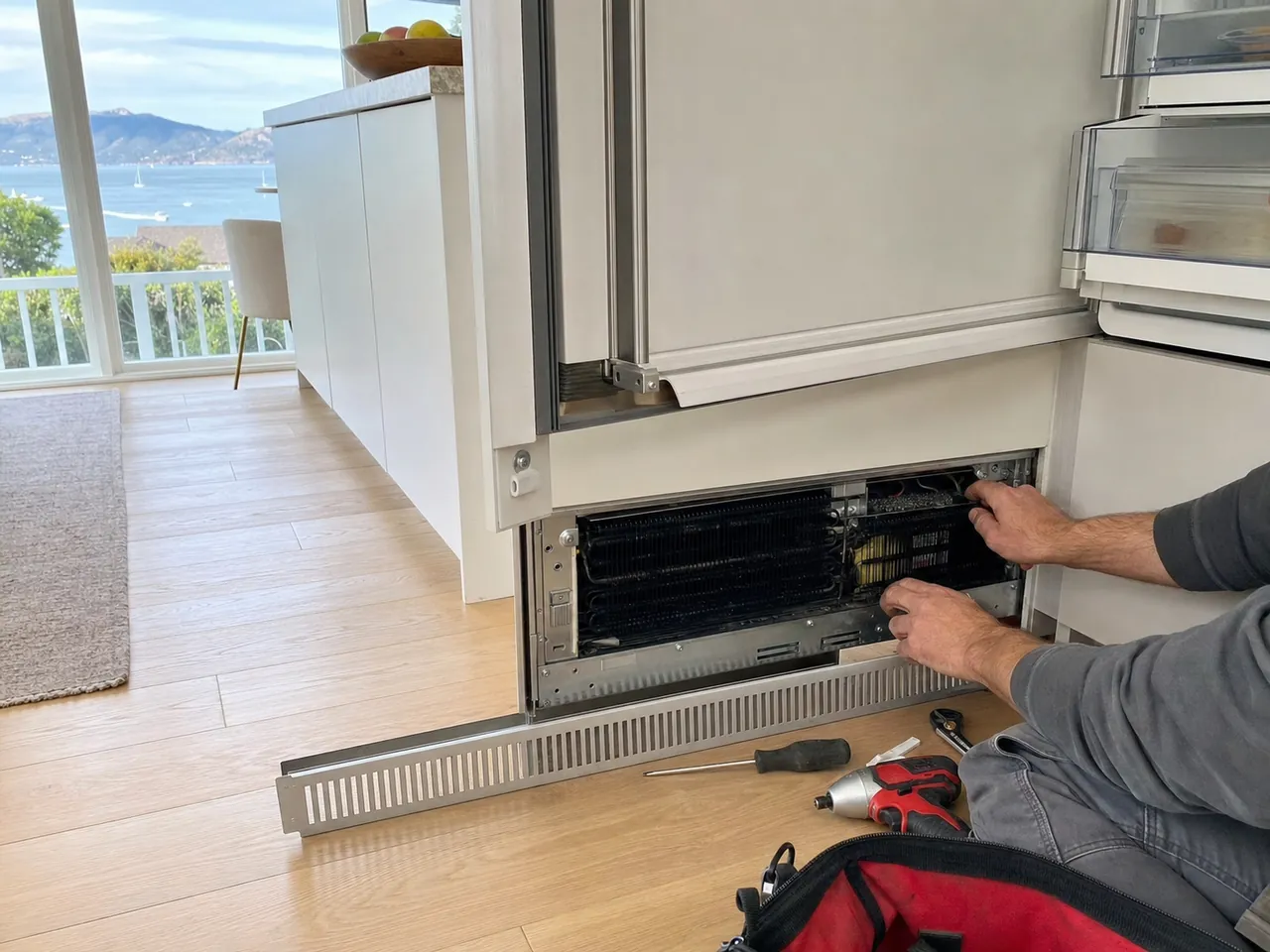
When BOTH zones drift warm together, the usual culprit is heat the unit can't shed. A wine column is often tucked into millwork with marginal venting, and the condenser coil loads up with dust over a few seasons. Here that is compounded by the bay: kitchens near Bridgeway and the Marinship breathe salt aerosol off Richardson Bay, which makes the coil mat denser and stickier than ordinary lint.
A clogged or salt-loaded condenser, a tired evaporator fan, or a vent boxed in by cabinetry all show up the same way — warm, slow recovery and a compressor that runs nearly nonstop. Clearing the coil and confirming the fan spins freely resolves a large share of these before anyone touches refrigerant.
Seals, UV glass, and vibration near the harbor
A wine cooler lives or dies on its door. The triple-pane, UV-tinted glass keeps light off the wine, and the gasket has to seal humid Sausalito marine air out — a perished gasket means the unit fights to hold humidity, frosts the evaporator, and runs hot. A gasket is a clean, bounded replacement.
Vibration is the other quiet enemy, and it matters more here than most places. A failing compressor mount or a fan bearing transmits a low hum into the cabinet, and steady vibration disturbs the sediment in older reds and stresses delicate corks over time. If a previously silent unit has started to buzz, it is worth a look before it costs you a vintage.
Repair or replace?
Sensors, dampers, gaskets, fans, control boards and a recharge are all economical repairs on a built-in that is worth several thousand dollars and integrated into the cabinetry — replacing one is rarely a like-for-like swap once you factor the panel and fit. The honest exception is a compressor or a leaking sealed system on an older unit; there we put the real numbers in front of you rather than guess.
We service Sub-Zero wine storage throughout Sausalito and the Marin waterfront, test before we replace, and back the work with a 365-day warranty. Call (415) 683-1487 or book online and tell us which zone is drifting.