
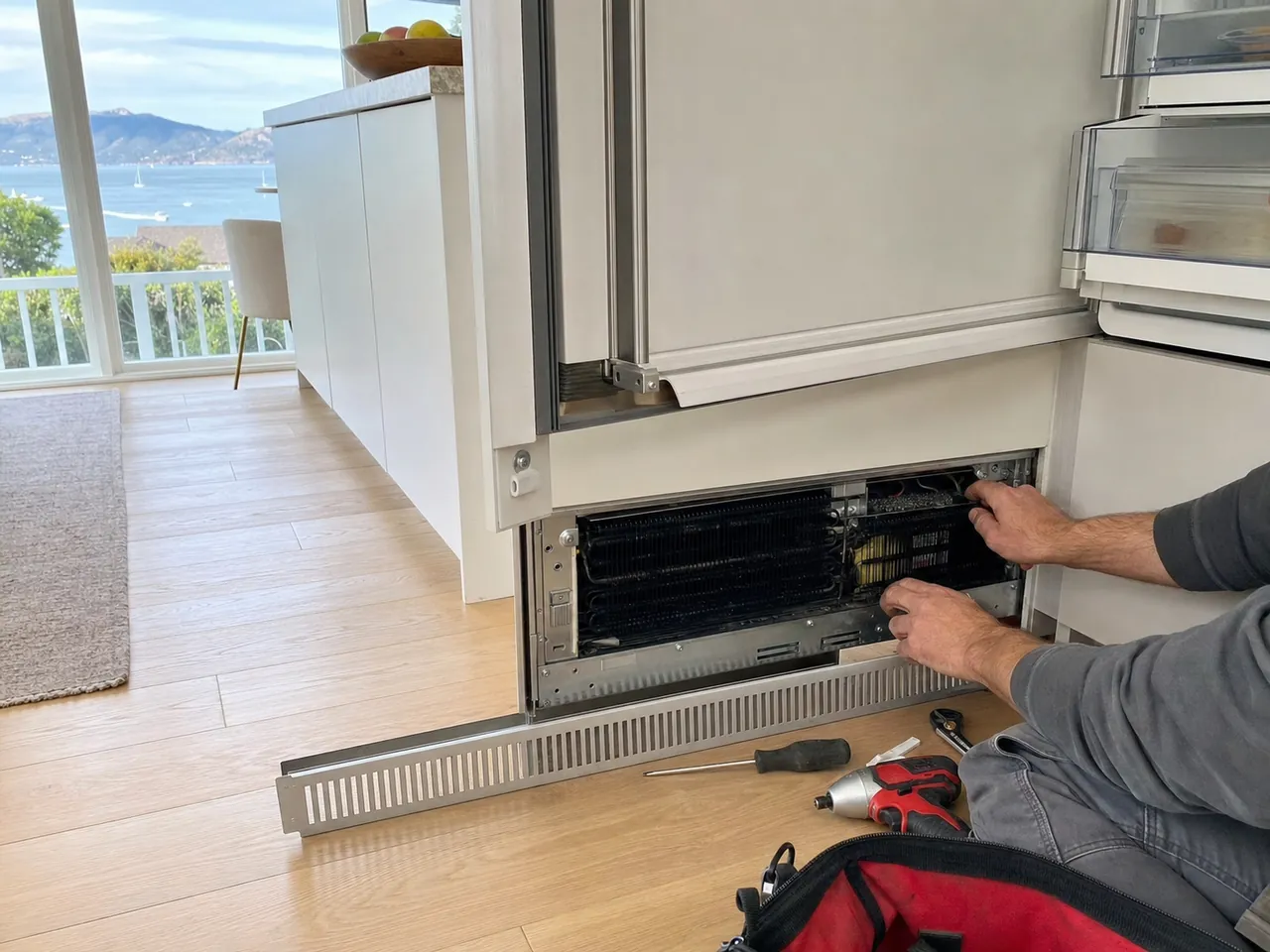
Few kitchens in the Bay Area live as close to open water as Sausalito's. Homes along Bridgeway, the Marinship flats off Marinship Way, and the famous floating-home community on the Richardson Bay docks all breathe air that has just crossed salt water. That single fact — proximity to the Bay — changes how a built-in Sub-Zero ages here in ways an inland kitchen never sees.
This is a practical care guide for owners on or near the Sausalito waterfront, drawn from the faults we actually find on local service calls.
Why salt air is harder on the machine
Air coming off Richardson Bay carries a fine salt aerosol. It is invisible, but it settles on everything — including the aluminum and steel inside your refrigerator's machine compartment. Over the seasons that film draws moisture and quietly accelerates corrosion on the condenser fins, the fan motor, and electrical connections.
On the houseboat docks the effect is strongest of all, because the unit is essentially over the water year-round. A condenser that might run a decade clean in a Mill Valley hillside home can load up far faster a few hundred feet out on a Sausalito dock.
The three things to watch
First, the condenser coil. Salt film plus the usual dust makes a denser, stickier mat than ordinary lint, so it insulates the coil sooner. A unit that can't shed heat runs warm and works the compressor hard.
Second, the door gaskets. Sausalito's damp, near-constant marine layer keeps the gasket line moist, and a tired gasket lets humid air in, which means more frost, more defrost cycles, and more strain.
Third, the exposed metal and connectors in the machine compartment. A light surface haze is normal near the water; flaking corrosion on a fan motor or a green crust on a terminal is a sign to have it looked at before it becomes a failure.
A waterfront maintenance rhythm
Owners right on the water do best with a condenser cleaning every six to nine months rather than the usual annual visit — the salt simply loads things faster. A few docks back from open water, once a year is usually fine.
When we service a waterfront unit we vacuum and brush the coil, check the gasket seal, and inspect the compartment metal and connections for early corrosion so a small clean-up doesn't turn into a fan-motor or board replacement later. Call or book online and tell us you're on or near the water — we'll plan the visit around dock or hillside access.